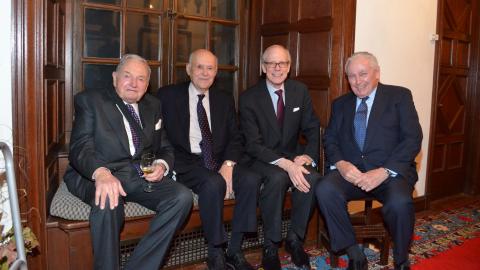
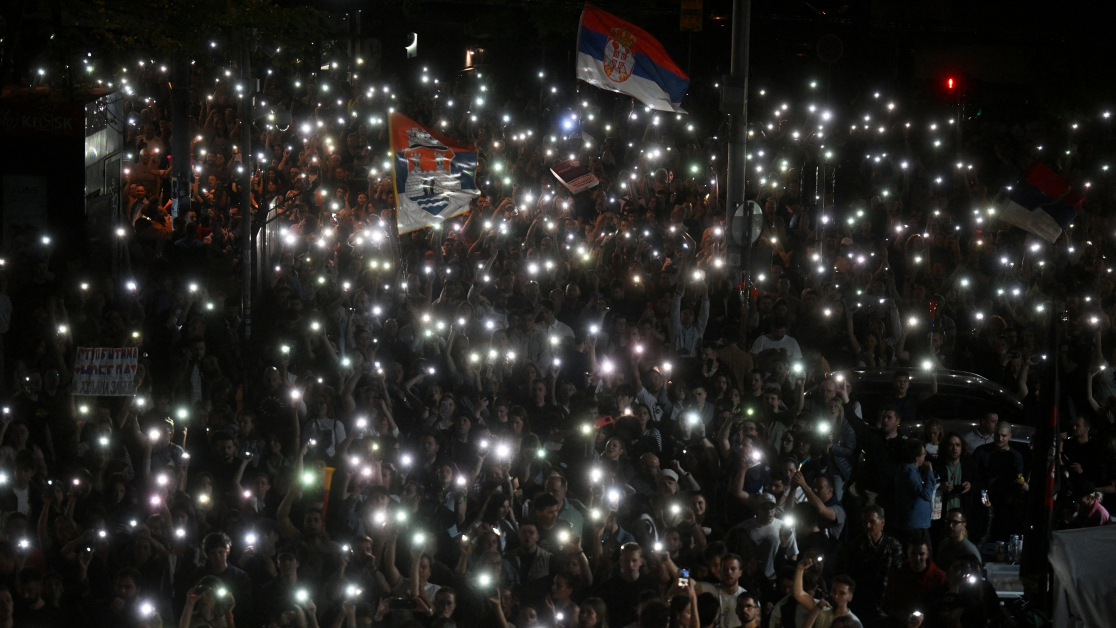
Photo by Olivier Bunic.
Photo by Olivier Bunic.
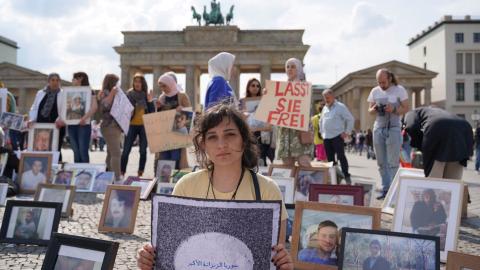
Serbian students and other protesters calling out corruption take part in a blockade of Serbia’s public broadcaster Radio Television of Serbia (RTS) in Belgrade, April 16, 2025.
In May 2025, Stephen Heintz, the longest-serving president in Rockefeller Brothers Fund history, announced his plans to retire the following summer after more than 25 years of leadership. Heintz’s tenure saw the Fund become a truly global institution, embracing the interconnected nature of today’s challenges and practicing what he called “acupuncture philanthropy”: leveraging modest assets at key inflection points to catalyze broad change. During his time at the helm, grantmaking surged from $25.6 million in 2001 to $65 million in 2025, and the endowment more than doubled to $1.4 billion, despite a financial crisis and a global pandemic, even as the foundation divested from fossil fuels.
Paramount to Heintz’s successful stewardship of the RBF were longstanding values rooted in the Rockefeller tradition of philanthropy and the charitable organizations that help us realize our mission, which in 2025 faced an unprecedented constellation of threats.
Executive orders, investigations, and other federal initiatives sought to constrict U.S. civil society and intimidate everyday Americans. Rollbacks of environmental, civil rights, immigration, and international policy and federal funding cuts reversed decades of domestic and foreign social progress. U.S. military strikes and withdrawal from international treaties signaled a sharp turn away from the multilateral engagement the RBF has long championed. Political violence at both ends of the ideological spectrum served as a dark reminder of the thinning line between liberty and tyranny.
"Democratic culture and the civil society that sustains it are not luxuries reserved for the few; they are essential to a vibrant and healthy democracy that promises life, liberty, and the pursuit of happiness for all."
- Stephen Heintz
President and CEO, October 2025
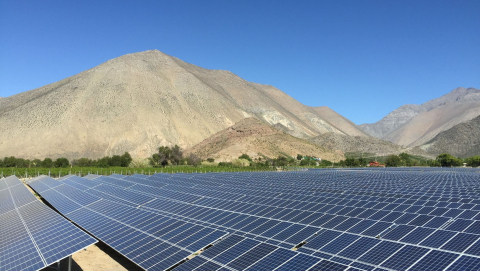
But 2025 also revealed the power in the horizontal bonds of civil society and community. Millions of Americans across all 50 states took to the streets in some of history’s largest peaceful protests to defend constitutional rights and liberties. Amid the withdrawal of U.S. international development dollars, local women's funds in the Balkans joined together in coalition to sustain support for women environmental defenders while reducing competition for increasingly scarce resources. Years of collaboration among Guatemalan civil society, Indigenous communities, and government institutions yielded significant carbon emissions reductions, winning the country $24 million from the World Bank's Forest Carbon Partnership Program. And more than 700 U.S. foundations, including the RBF, signed onto Unite in Advance to amplify the collective voice of the philanthropic sector when it and, most critically, the organizations it supports were under direct attack.
Years of investment in civil society laid the foundation for the resilience that 2025 demanded. A community of funders, charitable organizations, leaders, and committed individuals stood shoulder to shoulder, lighting the path toward a more just, sustainable, and peaceful world.
"At a moment that is fragile and fraught, we must rise to the higher standard we all collectively desire. Now is a moment for leadership that drives unity rather than sows further division."
- Unite in Advance, Joint Statement on Political Violence and Free Speech
September 17, 2025
The RBF met the urgency of the moment by increasing flexibility with grantees—by, for example, inviting renewal applications earlier and expediting grant payments—to afford greater stability amid uncertainty. We doubled down on our support for long-term, evidence-based strategies and forward-looking global commitments. The $1.8 billion Forest and Land Tenure Pledge, for example, links climate stability, biodiversity protection, Indigenous leadership, and community resilience. We also brought together grantees who have long worked to defend and restore democracy in Central America with peer organizations in the United States to share strategies on slowing or stopping the slide into authoritarianism.
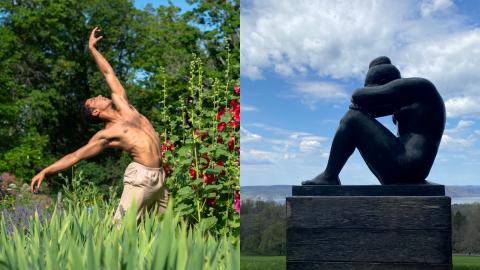
Creative encounters can bridge cultures, preserve history, and foster connection—all critical in a time of rising polarization and declining community bonds. Arts programming at The Pocantico Center is one way we harness that power.
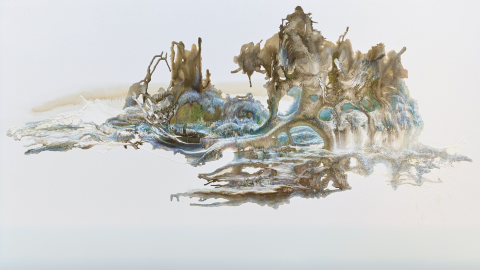
At Pocantico, 2025 was a year of firsts. It was the first year under the leadership of a new executive director, Meredith Horsford. We hosted the first Parent Artist Residency, recognizing that supporting artists and their families strengthens the creative ecosystem for everyone. We mounted our first joint exhibition and, for the first time, we presented the same performance on consecutive days, allowing more visitors to experience the show. In October, Shen Wei: Still/Moving, presented in partnership with the Katonah Museum of Art, opened in the David Rockefeller Creative Arts Center gallery. Over three days in September, Site Specific Dances invited audiences to navigate the estate as a living performance landscape with Sculpture Dances: Kykuit.
2025 Pocantico by the Numbers
Meetings & Conferences
Public Programs
Artists' Residencies
The RBF’s 2014 decision to divest from fossil fuels confronted the moral tension between funding climate solutions and investing in the very industry that obstructed sustainable policies.
In 2025, a case study authored by The Investment Integration Project (TIIP) analyzed the RBF’s ten-year investment performance, documenting a market-beating annualized return of 7.76 percent from 2014 to 2024 and an evolving understanding of the intersection between climate philanthropy and investment strategy.
The RBF’s decade-long experience helped build the field of mission-aligned investing from just a few fund managers who offered fossil fuel-free options in 2014 to a global movement with more than $40 trillion in divested assets under management. Alongside peers, grantees, and investment professionals who share our mission-oriented approach, the Fund has demonstrated that aligning capital with purpose is not a concession but a strategy for long-term resilience and collective impact.
2025 Spending by the Numbers
Total Spending 4
Payout Rate
As of December 31, 2025
Financial figures reported here for 2025 are unaudited and will be updated upon completion of the 2025 audit.
For definitions of allocation categories and up-to-date information about the Fund’s divestment progress, impact investments, ESG investments, and Gender and Racial Equity Lens investments, please visit our website. Detailed financial information is available in the Fund’s annual 990PF form and audited financial statements.
Increasingly acute attacks on philanthropy and civil society in 2025 prompted us to comprehensively and concisely articulate our values to help promote and defend our work. These values provide a compass for decision-making built on the reality of global interdependence, which has been central to the Fund’s approach for decades. Rooted in the Rockefeller family’s philanthropic tradition, our values guide not only why but how we pursue impact.
2025 Trustees by the Numbers
Trustees Served
Rockefeller Family Trustees
Trustees Identify as Women
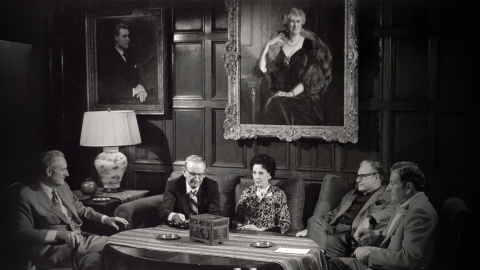
"What I would like you always to do is what I try humbly to do myself: that is, never to say or to do anything which would wound the feelings or the self-respect of any human being, and to give special consideration to all who are in any way repressed."
- Abby Aldrich Rockefeller
in a letter to her sons, 1928
1. Donor contributions from individuals and other foundations expand the Fund’s available resources and impact. Grants awarded include approved grants that subsequently lapsed and differs from grants paid because some grants are payable over more than one year. See the Finance section for total 2024 grants spending. Back to report →
2. Additional grantmaking supports distinct institutes and initiatives through universities and fiscal sponsors, operating as general support. Back to report→
3. Grants paid differs from grants awarded because some grants are payable over more than one year. Non program-related grants to support Philanthropic Stewardship, Pocantico conferences, employee matching gifts, president’s and vice presidents’ discretionary giving, and the Staff Grantmaking Fund account for 15 percent of 2024 grants paid. Back to report→
4. Not including investment fees. Back to report→
5. Includes consultancies and other expenses that advance the Fund’s mission but do not take the form of traditional grants. Grants spending differs from grants awarded because some grants are payable over more than one year. See the Grantmaking section for total 2024 grants awarded. Back to report→
6. Percentages reflect current dollars deployed. Back to report→
7. Individuals employed may exceed the number of staff positions to account for both new hires and terminations for the same role. Staffing figures do not include short-term internship positions. Back to report→
8. Four percent of staff identify as non-binary, and 22 percent identify as men. Back to report→
8. Trustee demographic data collection processes were updated in 2024. Because individuals can select more than one demographic category, totals may add up to more than 100 percent. Back to report→