
Justice & Equity in Grantmaking
The Rockefeller Brothers Fund pursues justice and equity across all grantmaking programs.
The Fund’s mission and values guide our grantmaking approach. Increasing global interdependence means that the interrelated challenges of climate change, democratic decline, and violent conflict cannot be solved without broad participation, especially from communities that have historically faced discrimination and exclusion. Solutions that ignore historical discrimination and the people who experience the resulting inequities omit key knowledge and risk exacerbating the very problems the interventions aim to address.
We will not achieve the Fund’s program goals without addressing persistent exclusion, marginalization, and disadvantage.
Social stratification and exclusion exist nearly everywhere, but the underlying beliefs, structures, and practices vary by geography, history, and culture. Marginalization and disadvantage often exploit differences in race, ethnicity, economic status, religion, sexual orientation, gender identity, geographic location, and ability. While striving to consider all of these dimensions, and recognizing that identities are multifaceted, the RBF is attentive to race, ethnicity, and gender—and their distinct presentations in the contexts where we work—for the purpose of addressing justice and equity through our grantmaking.
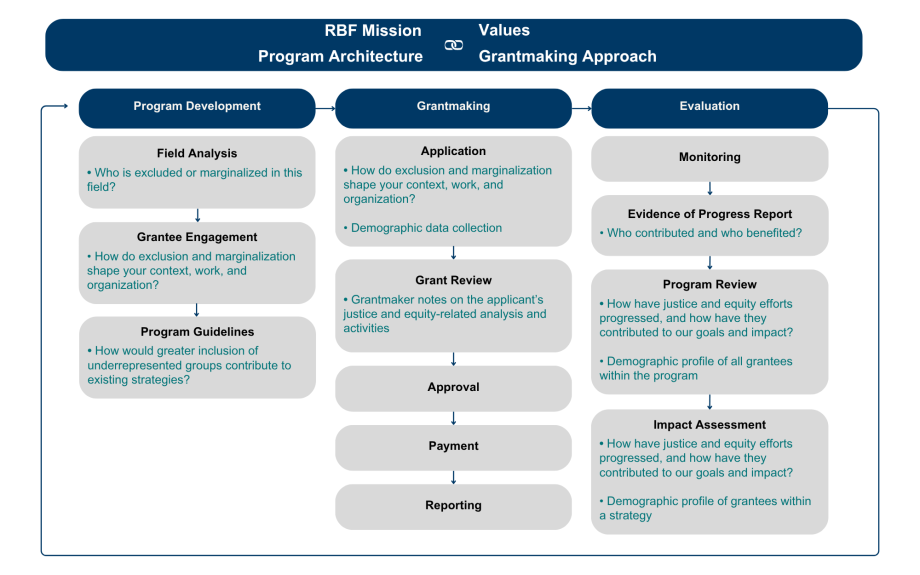
Over the last five years, we have integrated a new set of tools that embed attention to inclusion and participation of marginalized groups into our processes for program development, grantmaking, and evaluation. These tools aim to enhance existing practices rather than invent new ones and avoid undue burden on grantees or staff. We use consistent systems—adaptable to different geographies—across our programs to ensure cumulative, durable impact and accountability.
Program Development
Program development includes field analysis, engagement with grantees and partners, and the creation of program guidelines that express the goals and strategies we pursue with our grantmaking.
Field analyses present data on both the challenges facing a program’s area of interest and current work to address those challenges. The field analysis now also includes an assessment of how certain groups are harmed by related policies or lack access to institutions, resources, and opportunities to contribute to solutions, as well as the implications for achieving program goals. It identifies trends, gaps, and needs that our grantmaking should address.
Grantee engagement helps us monitor evolving context, understand what’s working (and what’s not), and identify opportunities to support innovation. To prompt conversations on justice and equity, we started talking with grantees about three dimensions:
Your Take: What are the patterns of discrimination and marginalization in your area?
Your Work: How does your organization address discrimination and marginalization?
Your Organization: What internal practices illustrate your efforts to embrace and advance justice and equity?
Program guidelines are the board-approved articulation of the Fund’s goal and strategies for each program, which communicate our priorities to grant seekers and provide staff with parameters for how they can make grants. Rather than adding a separate goal or strategy to address justice and equity, we began asking our grantmakers each year to explore how greater inclusion of underrepresented groups would contribute to existing program strategies and impact. Using this lens, they chart grant opportunities and grantmaking tactics that could elevate new voices and address justice and equity-related challenges that impede progress toward the program goal.
Grantmaking
Grantmaking encompasses the entire lifecycle of a grant, from application to review and, finally, payment.
A grant application includes a narrative proposal, proposed budget, and supporting operational and financial information. In 2022, we added guidance for grantseekers recommending they include in their grant proposal “a discussion of how race, ethnic, and/or gender discrimination and exclusion shape your context, your work, and your organization.”
We also began to collect more detailed demographic data in the online grant application. Because social stratification varies by society, we offer forms tailored to the United States and to our pivotal place programs in China, Central America, and the Western Balkans, as well as a general “international” form for organizations based elsewhere outside the United States. The data is not used in grantmaking decisions but helps us understand how an organization’s leadership reflects the communities it serves and how that changes over time. It also enables portfolio-wide analysis.
Grant review is the due diligence process by which we assess applications for programmatic alignment and legal compliance. During the review process, grantmakers now make notes on the grantee’s justice and equity-related analysis and activities drawn from proposal narratives, reports, and follow-up conversations. These notes help us track grantees’ attention to exclusion, marginalization, and disadvantage across multiple grant cycles.
Payment on grants is made only after the review process is complete and the grant is approved.
Evaluation
The Fund evaluates impact through annual evidence of progress reports, program reviews every three to five years, and impact assessments every five to 15 years.
Evidence of progress reports track concrete changes in behavior, understanding, capacity, public engagement, and policy that advance our program goals. We compile our findings annually and present them to the board every other year. In addition to capturing grantee work that contributed to progress, the reports now reflect on which historically marginalized and underrepresented groups contributed to or benefited from progress, and who remains left out.
Program reviews, conducted internally by RBF staff, reflect on the program’s grantmaking, resource allocation across strategies, key accomplishments, and changes in the context. They often recommend modest revisions to the program’s goal and strategies. Impact assessments evaluate specific strategies as a body of work matures. Staff contract with consultants to prepare an impact assessment that incorporates robust external perspectives and stakeholder interviews to discern enduring outcomes. Drawing on field analysis, grantee engagement, demographic data, grantmaker notes, and evidence of progress reports, both program reviews and impact assessments now include portfolio-wide demographic profiles and analysis of how efforts to address exclusion and marginalization have progressed.
Findings from the evaluation stage feed back into program development, beginning the cycle anew. As each step in the RBF grantmaking process intentionally addresses justice and equity, we can begin to assess our progress in incorporating these considerations into our grantmaking and adjust in real time, iteratively strengthening our efforts to build a world that is more just, sustainable, and peaceful for all.