
Photo courtesy of the United States Department of State.
Photo courtesy of the United States Department of State.
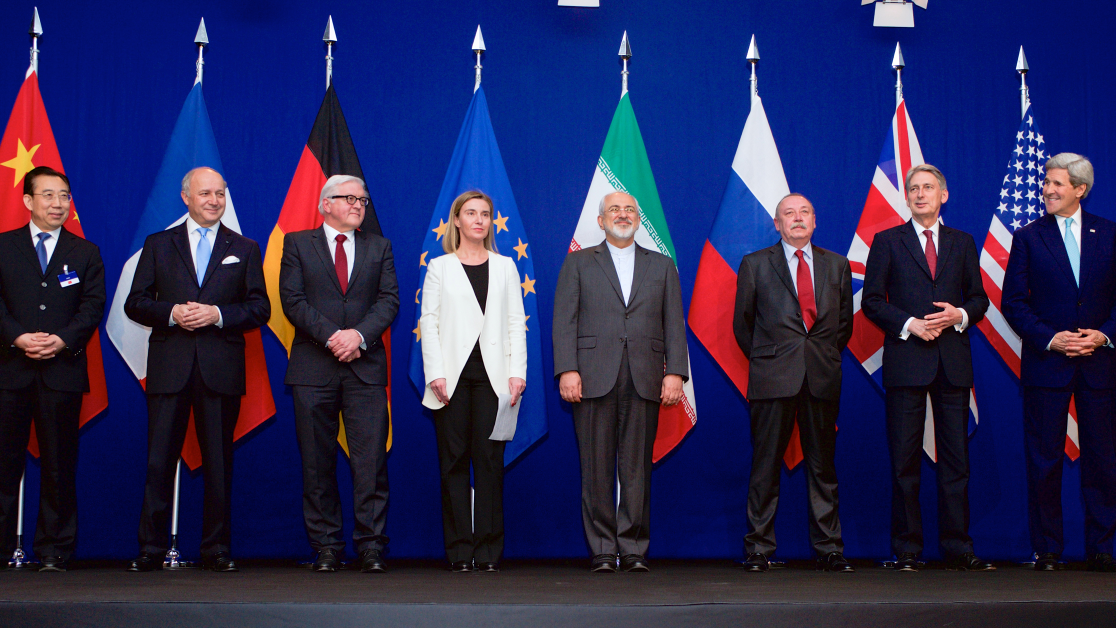
Former Secretary of State John Kerry alongside P5+1 leaders and Iranian Foreign Minister Zarif, following negotiations about future of Iran's nuclear program.
On June 27, 19 former diplomats, scholars, researchers, and other experts joined Ploughshares and the Iran Project to release the following statement:
The U.S. attack on three Iranian nuclear facilities over the weekend was a dangerous military action, derailing ongoing negotiations to prevent Tehran from developing a nuclear weapon while bringing the US and Iran to the brink of an all-out war.
Just a few days earlier, President Trump stated that reaching a political agreement with Iran was a priority, and set a two-week window to continue diplomatic talks. As national security and foreign policy professionals, we call on the Trump Administration to redouble efforts to secure the nascent ceasefire deal between Israel and Iran and commit to a serious diplomatic process to ensure that Iran never acquires a nuclear weapon. Diplomacy is the most viable path to prevent Iran from developing these weapons in the long run.
Prior to the strikes on Saturday, the U.S. intelligence community had assessed that Iran had not made a decision to build a nuclear bomb, and was several months away, if not longer, from being able to assemble a crude device. Despite this assessment, President Trump launched a military operation on three key nuclear sites in Iran that were under International Atomic Energy Agency’s (IAEA) safeguards. These strikes dramatically reduced the IAEA’s visibility into Iran’s nuclear activities and were carried out while talks between European and Iranian diplomats were underway, risking the possibility of Tehran’s withdrawal from the Nuclear Non-Proliferation Treaty.
Iran’s retaliatory strikes on the U.S. military’s Al Udeid Air Base in Qatar on Monday appear to have been calibrated and messaged in advance, indicating a desire to contain tensions and head off a wider confrontation. Now is the time for the U.S. to pursue a return to talks with Iran with realistic expectations to secure a strong nuclear agreement. A top priority should be a swift return of IAEA inspectors to key facilities in Iran.
Recent polling shows that there is strong support among Americans for U.S. leadership to achieve a diplomatic solution to address Iran’s nuclear activities. American service members should not be asked to fight in another unnecessary war in the Middle East, nor should the American people be asked to pay for it. President Trump has spoken of the need to curb the threat of nuclear weapons. We, the undersigned individuals, urge the President, with the full support of the U.S. Congress, to be the historic leader that secures an effective, verifiable negotiated agreement that prevents an Iranian nuclear weapon.
Stephen Heintz, President, Rockefeller Brothers Fund
James Acton, Co-director, Nuclear Policy Program, Carnegie Endowment for International Peace
Alexandra Bell, Former Deputy Assistant Secretary for Nuclear Affairs, Bureau of Arms Control, Deterrence, and Stability, U.S. Department of State
Emma Belcher, President, Ploughshares
Thomas M. Countryman, Chairman, Board of Directors, Arms Control Association
Toby Dalton, Co-Director, Nuclear Policy Program, Carnegie Endowment for International Peace Kelsey Davenport, Director for Nonproliferation Policy, Arms Control Association
Suzanne DiMaggio, Senior Fellow, Carnegie Endowment for International Peace
Robert Einhorn, Former Assistant Secretary for Nonproliferation and the Secretary of State’s Special Advisor for Nonproliferation and Arms Control; Senior Fellow, Brookings
Frank N. von Hippel, Professor of Public and International Affairs emeritus, Princeton University Ambassador
Bonnie Jenkins, Former Under Secretary of State for Arms Control and International Security
Laura Kennedy, Former U.S. Ambassador to the Conference on Disarmament; Former U.S. Chargé at U.S. Mission to International Organizations; Arms Control Association Board
Daryl G. Kimball, Executive Director, Arms Control Association
George A. Lopez, Professor emeritus, Kroc Institute, University of Notre Dame
Jessica T. Mathews, Former Director of the Office of Global Issues of the National Security Council
Stephen D. Mull, Former Acting Under Secretary for Political Affairs, U.S. Department of State
Tom Pickering, Former Under Secretary of State for Political Affairs and Ambassador to the United Nations, Israel, Russia, India, El Salvador, Nigeria, and Jordan
Paul R. Pillar, Former National Intelligence Officer for the Near East and South Asia, Georgetown University
Gary Sick, Captain US Navy (ret); Columbia University
Jim Walsh, Senior Research Associate, MIT Security Studies Program
All affiliations are listed for identification purposes only.