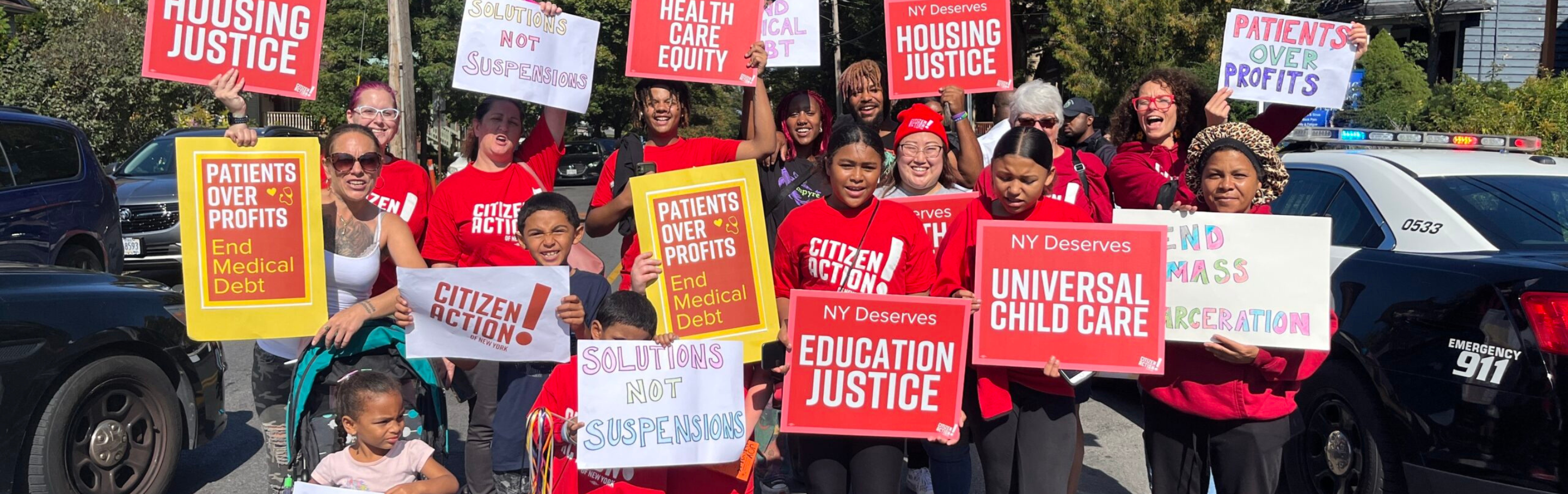
Photo courtesy of Citizen Action of New York
Photo courtesy of Citizen Action of New York
Public Policy and Education Fund of New York helps amplify the voices of everyday New Yorkers in local, state, and federal governance and policy.
Democracy in the United States is facing myriad challenges as persistent and deep divisions undermine the nation’s social, economic, and political vitality. The nation is embroiled in a crisis of legitimacy across its formal and informal institutions, as governing and civil society institutions struggle to meet the demands of citizens and residents for responsive, efficient, and effective governance. The current U.S. political system suffers from outsized influence of money in politics, extreme partisanship, retrenchment of voting rights, outdated and inefficient government operations and governance models, a fractured and polluted information ecosystem, and concentrations of power in narrow segments of society that do not reflect the broader population.
Gaps are widening between rich and poor, White and non-White, and the diversity of elected officials remains misaligned with the electorate, fundamentally undermining the quality of representative democracy. A very small segment of society spends exorbitant amounts of private money on political campaigns and lobbying, profoundly distorting the political system and establishing an openly oligarchical force. That distortion destroys the positive cycle of democratic accountability—making it difficult for constituents to hold elected officials accountable—and fosters cynicism and distrust of elected officials and public institutions.
The quality of U.S. political culture continues to deteriorate. There are fewer and fewer examples of constructive compromise in local, state, and federal legislatures. Political actors, with the goal of achieving partisan supremacy rather than ensuring democratic fairness, exert improper control over voting rights, poll access, and redistricting. Participation in U.S. national elections remains below that of most other advanced democracies, and turnout for local elections is persistently low. Moreover, fair, efficient, and effective election administration is undermined by underinvestment in local elections offices. Eligible voters have been kept from the polls by restrictive voting laws—or worse, by overt voter suppression efforts.
Meaningful and informed public participation is the foundation of a truly vibrant democracy and gives rise to transformative policy ideas that truly reflect fair and effective representation. Support for grassroots organizing, development of civic leadership opportunities for underrepresented populations, and adoption of effective civic innovations and digital tools to improve community and constituent engagement are promising ways to improve public participation in governance.
The Fund focuses on the intersection of democratic systems and democratic culture in the United States, supporting efforts that advance the practice of democracy: how theories, research, and skills are put into practice to realize constitutional promises for the nation’s future. DPUS grantmaking aims to address the demands of citizens and residents to participate in a political economy that serves their needs while honoring individual and collective self-determination and lived experience.
The Fund supports movement building, innovation, and reform efforts to advance social, economic, and racial justice and reverse authoritarian and oligarchical trajectories in U.S. governance.
Program Director
Program Associate
The Democratic Practice–U.S. program funds organizations and initiatives that work to transform systems and institutions with a keen understanding of and attention to shifting power dynamics. The program does not generally fund deliberative democracy projects or localized voter registration and Get Out the Vote efforts, nor provide general support for journalism and documentary film production. The RBF does not provide funding to 501(c)(4) lobbying organizations but can make grants to affiliated 501(c)(3) organizations for charitable activities. By law, the RBF cannot provide funds earmarked for lobbying. Read more about What We Fund.