

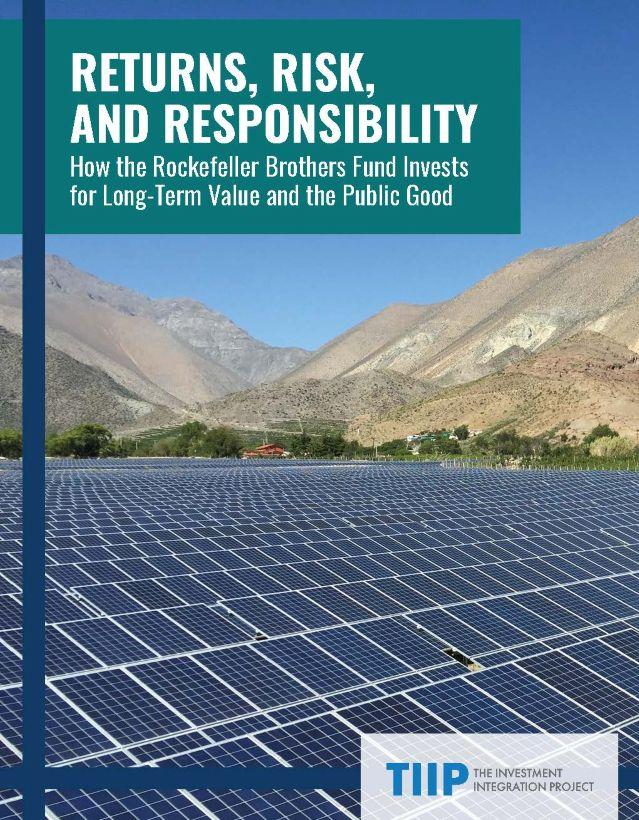
RRG Sustainable Water Impact Fund LP portfolio company Azul Solar aims to provide clean energy to Chile’s largest metropolitan area, Santiago, through solar energy projects. Photo courtesy of Cerity Partners OCIO.
RRG Sustainable Water Impact Fund LP portfolio company Azul Solar aims to provide clean energy to Chile’s largest metropolitan area, Santiago, through solar energy projects. Photo courtesy of Cerity Partners OCIO.
Today, The Investment Integration Project (TIIP) released Returns, Risk, and Responsibility: How the Rockefeller Brothers Fund Invests for Long-Term Value and the Public Good, a landmark 10-year review of the charitable foundation’s investment strategy following its 2014 decision to divest from fossil fuels.
The report, commissioned by the Rockefeller Brothers Fund (RBF), documents a track record of above-market returns, definitively demonstrating that investors can align financial assets with strategic purpose without sacrificing performance.
“Our experience over the last decade confirms that mission-aligned investing isn’t a tradeoff—it’s a strategy for long-term value creation, financial resilience, and multiplying our impact,” said Stephen Heintz, RBF president and CEO. “This report shows how institutional investors can simultaneously grow their assets and contribute to tangible, systemic advances.”
The RBF’s portfolio has outperformed the benchmark over the past 10 years, generating an annual return of 7.76 percent with 27 percent less risk than the benchmark. Today, the portfolio is 99.7 percent fossil fuel-free with a plan in place to further decarbonize in line with science-based targets. Over 20 percent of its holdings are in impact investments, and there is 25.5 percent equity ownership by women and/or people of color among its investment managers.
“Our goal was always to combat the narrative that you have to be willing to lose money to do good,” said Geraldine Watson, executive vice president for finance, operations, and Pocantico at the RBF. “We felt that proving otherwise was one way we could leverage our modest financial assets for maximum impact.”
The report also shows how the field of socially responsible investing has evolved alongside the RBF, which has contributed substantially to its progress. The RBF and Cerity Partners OCIO have reinvented the client-manager relationship, partnering to develop, test, and share new frameworks and tools to build the field. The RBF has also supported, through its own practices as well as grantmaking to industry and philanthropic coalitions, new data collection and measurement standards. It has offered its facilities as space for collaborative innovation between investors, analysts, and advocates.
“The RBF has been a leader in system-level investing,” said William Burckart, president and CEO of TIIP. “As we spoke to other foundations and institutional investors, we found the RBF’s proactive transparency and willingness to experiment invaluable assets to others who are interested in this area but concerned about performance drag or implications related to fiduciary duty. The RBF offers a concrete example of an investor who continues to adapt and explore new opportunities to contribute to system-level progress.”
As institutional investors face intensifying scrutiny around ESG, fiduciary duty, and systemic risk, the RBF’s story reveals a critical truth: that fiduciary responsibility today requires cross-spectrum engagement with the environmental and social challenges that shape long-term outcomes.
The full report, Returns, Risk, and Responsibility: How the Rockefeller Brothers Fund Invests for Long-Term Value and the Public, is available for download here.