
Photo by Joseph Pierson.
Photo by Joseph Pierson.
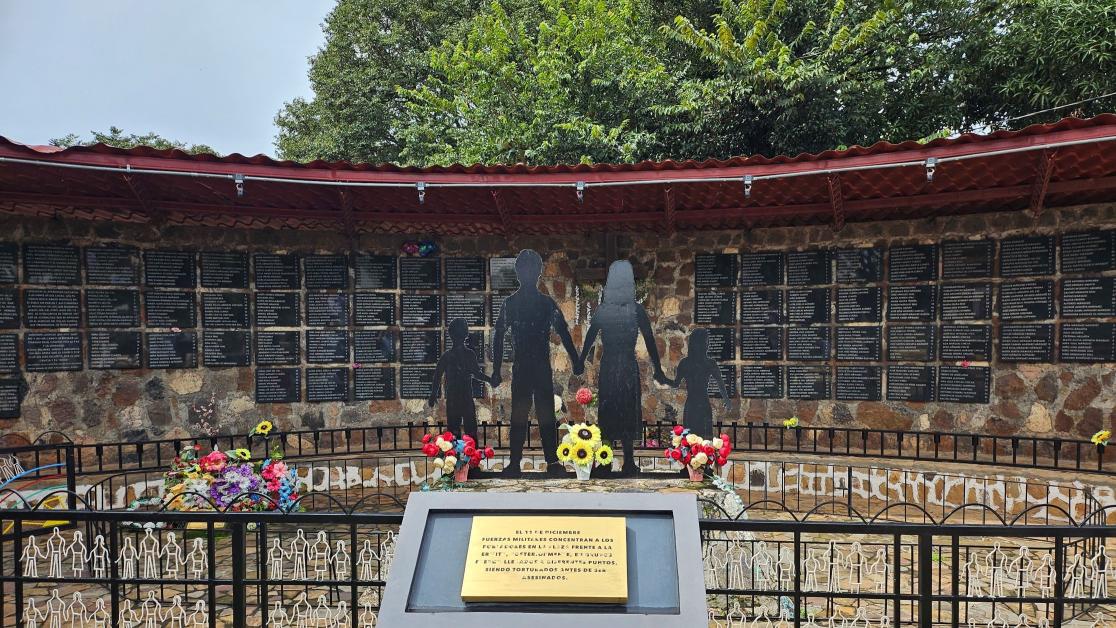
A monument to victims of the 1981 massacre in El Mozote, El Salvador.
In December 1981, during El Salvador’s civil war, soldiers of the Salvadoran Army’s American-trained Atlácatl battalion entered the rural town of El Mozote and carried out the largest massacre of civilians—many of them children—in Latin American history. In the years since, the victims’ families have sought to hold those responsible to account. They have won key victories along the way, including a formal apology by the government of El Salvador in 2011, but true justice remains elusive.
During a recent visit to Guatemala and El Salvador, a delegation of RBF staff and trustees traveled to El Mozote to meet with some of the families who lost loved ones in the massacre. (The human rights organization Cristosal, their long-time advocate, is an RBF grantee.) It was inspiring to see their resolve, even after decades of delays and setbacks; I remember learning about the massacre in college, around 2006, and thinking of it, even then, as settled history. The fact that major breakthroughs toward accountability have been made in the twenty years since is a testament to their perseverance.
When describing RBF’s work abroad, I’ve occasionally been asked, Why should a U.S. foundation divert resources to other countries when there are so many pressing challenges at home? Or even, what right does RBF have to get involved in other countries’ affairs at all? With the cancellation of USAID contracts and the reduction in force at the State Department, these questions have taken on a more immediate dimension.
RBF’s engagement with this seemingly remote and protracted struggle in El Mozote is instructive, as it speaks to what I have come to understand, following the recent trip to Guatemala and El Salvador, as a common thread connecting much of the Fund’s work in Central America, in the United States, and around the world.
Accountability.
Holding power to account informs, for example, the Democratic Practice program’s support for those working to make governments more responsive to their constituents; it underpins the Peacebuilding program’s multilateral approach to conflict and frames the Sustainable Development team’s push for a full accounting of fossil fuels’ costs to human and environmental health.
For the RBF’s Central America program, which focuses on Guatemala, El Salvador, and Honduras, I think it is fair to say accountability sits at the very heart of its grantmaking. The program’s grantees, some of whom we met on our visit, include journalist networks working to maintain independent media across the region, environmental organizations using data collection to monitor extractive and polluting industries, and anti-corruption groups combating government impunity.
Grantees' work requires commitment, sacrifice, adaptability, and, all too often, courage. In Totonicapán, we met with the Board of Directors of 48 Cantones, an Indigenous group that played a key role in the pro-democracy protests that prevented Guatemala’s Attorney General and Constitutional Court from blocking the inauguration of democratically elected President Bernardo Arévalo. The Guatemalan Prosecutor’s Office has since arrested two of their directors, as well as other Indigenous leaders, accusing them of sedition, terrorism, illicit association, and obstruction of justice for their roles in the protests—charges local human rights organizations claim are political reprisals for their exercising the right to peaceful assembly.
The fight for accountability, and its corollary, the ability to speak freely without fear of retribution, is not limited to Central America. To quote Martin Luther King, Jr.’s Letter from Birmingham Jail, written in a historical moment to which my family has a connection, “Injustice anywhere is a threat to justice everywhere. We are caught in an inescapable network of mutuality, tied in a single garment of destiny. Whatever affects one directly, affects all indirectly.”
This idea echoes in RBF’s motto, “Philanthropy for an Interdependent World,” and animates its sustained engagement with partners in pivotal places around the world.
It is a source of great encouragement knowing there are people out there who don't give up. In their commitment to a more just future, they inspire and inform the RBF’s work at home and abroad.